The AI dating clarity platform helps users review message patterns, reduce overthinking, and approach conversations with more confidence.
Modern dating often begins with a match, but the real uncertainty usually arrives after the conversation starts. A message may sound interesting without leading to a plan. A reply may feel warm one day and distant the next. For many women, that uncertainty can turn a few lines of text into a long cycle of screenshots, group chat opinions, and second guessing.
VIXA was created for that space between matching and deciding what to do next. Rather than positioning itself as another dating app, the company describes VIXA as an artificial intelligence powered dating clarity platform for women who want a more structured way to understand digital conversations.
The platform is led by founder and chief executive officer Lisa Haven, who is based in Boca Raton, Florida. According to company materials, Haven built VIXA after observing how often women rely on friends, online communities, and repeated rereading to interpret unclear dating communication. That human experience gives the product a practical focus. It is not designed to promise a perfect relationship. It is designed to help users look more carefully at what is already happening in a conversation.
At the center of VIXA is Vela, the company’s artificial intelligence companion. Users can upload screenshots or paste text based conversations from dating apps, text messages, or social media direct messages. Vela then reviews details such as tone, timing, effort level, response gaps, and consistency. The goal is to help users identify patterns that may be difficult to notice when emotions are involved.
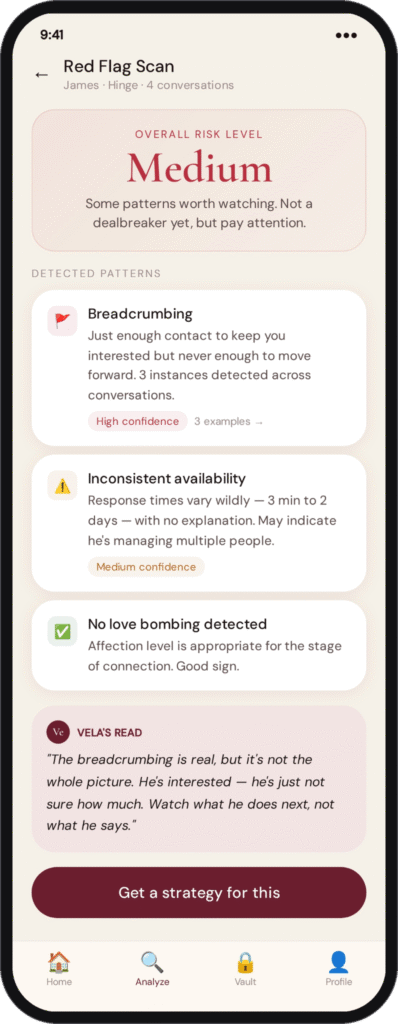
The platform can surface behaviors commonly discussed in modern dating, including breadcrumbing, inconsistent availability, low effort communication, and mixed signals. Instead of simply calling a conversation positive or negative, VIXA is built to explain what it is reading and why. That distinction is important because dating uncertainty often becomes more stressful when a person cannot separate facts from feelings.
VIXA’s private vault feature is also designed around patterns rather than one isolated exchange. A confusing message may not say much on its own, but repeated delays, vague plans, or attention that appears only at convenient times can tell a clearer story. By allowing users to save selected analyses, the vault gives them a way to look back at recurring communication habits with more distance.
Privacy is a central part of the platform’s positioning. VIXA states that uploaded conversations are encrypted, processed privately, and deleted within 30 days unless a user chooses to save them. The company also states that employees do not read private user conversations and that it does not sell user data. Because the app handles personal communication, users should still be thoughtful about what they upload and avoid sharing sensitive details that are not needed for an analysis.
VIXA is currently in pre-launch and is offering early access opportunities through its waitlist. The company says it is launching on iPhone first, with Android support planned after the iOS launch. VIXA Premium is described on the company’s website as starting with a three day free trial, followed by weekly or annual plan options. Listed features include red flag detection, green flag detection, reply suggestions, exit scripts, and conversation analyses.

The product arrives at a time when many people are using technology not only to meet others, but also to manage the communication that follows. Dating apps can introduce two people, but they do not always help users interpret unclear behavior after the match. VIXA attempts to serve as a layer between the first conversation and the next decision, helping users pause before responding, committing more energy, or moving on.
The strongest use of a tool like VIXA is as a support system, not as a substitute for judgment. A dating clarity app can organize signals and identify patterns, but it cannot know every personal context behind a relationship. Users still need to rely on their own boundaries, trusted support systems, and basic safety habits when meeting or continuing conversations with someone new.
For women who feel drained by vague messages, shifting energy, or repeated uncertainty, VIXA offers a more organized way to review what is in front of them. Its value lies in helping users slow down, look at evidence, and make choices with more perspective. In a dating culture where signals can be confusing, that kind of clarity may be the tool many women have been trying to create for themselves.
Readers can learn more about VIXA and its early access waitlist at vixaapp.ai. They can also follow Lisa Haven’s founder journey at lisahaven.co, including her work with LUMAPROMPT.AI and Havenly.
Women’s Insider Contributor
Lauren E. Whitman
Lauren E. Whitman covers women in business, lifestyle trends, and personal growth. Her work focuses on practical insights that help readers navigate modern careers and everyday life.
This article features partner, contributor, or branded content from a third party. Members of the Women’s Insider editorial staff were not involved in the creation of this content. All views and opinions are those of the contributor alone.