For women navigating perimenopause and menopause, skincare can become more complicated at exactly the moment the beauty industry becomes louder.
Dryness, changes in texture, reduced firmness and shifts in skin resilience can appear gradually, while brands compete for attention with percentages, clinical language, ingredient claims and increasingly sophisticated marketing.
But what should consumers actually look for?
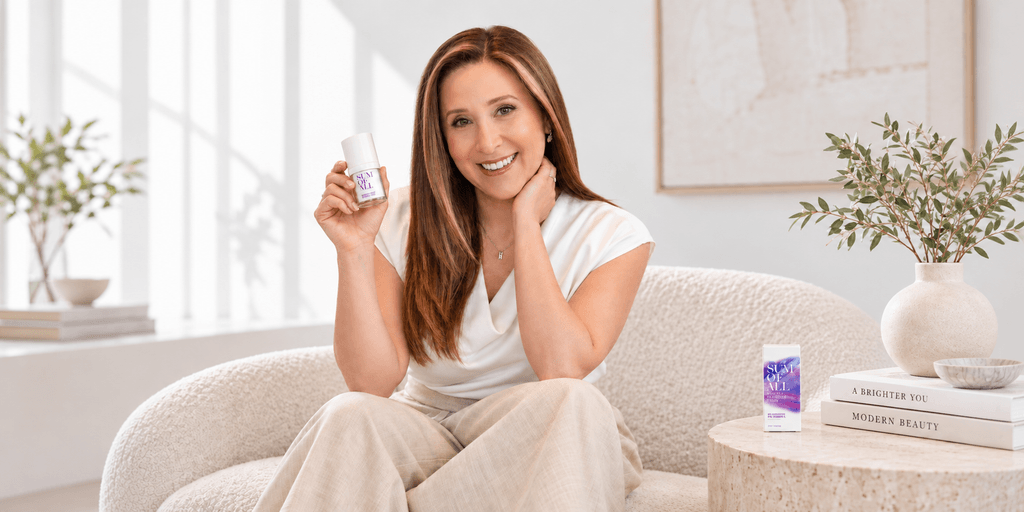
To better understand the difference between meaningful evidence and persuasive marketing, we spoke with Stacey Berger, Founder and CEO of SUM OF ALL, a skincare brand developed specifically for hormonally changing skin.
Rather than focusing on which product promises the most, Berger says consumers may be better served by asking what was actually tested, how the result was measured and whether the finished formula—not simply one ingredient—was evaluated.
Q: Skincare brands use the word “clinical” constantly. What should consumers understand about that?
Stacey Berger: The word itself does not always tell you very much. The first question I would ask is: What exactly was tested?
There is an important difference between testing an individual ingredient and testing the finished product a consumer is actually purchasing.
An ingredient may have excellent research behind it, but once it is incorporated into a formula, concentration, stability, delivery system and interaction with other ingredients all matter.
Finished-product testing can help show how the actual formula performs rather than asking consumers to assume that an ingredient study automatically translates to the finished product.
Q: What is the difference between a clinical study and a consumer perception study?
Berger: They can both be useful, but they are measuring different things.
A consumer perception study asks participants what they see or feel. Someone might report that her skin feels smoother, looks brighter or appears firmer.
That tells you about the user experience, which is important.
Clinical or instrumental testing can measure something more objectively, such as hydration, barrier function, wrinkle depth or surface texture.
So, if a brand says “90 percent of women said their skin looked firmer,” that is very different from saying researchers objectively measured a specific change in firmness.
Consumers should know which type of result they are looking at.
Q: Do you think consumers sometimes misunderstand percentages in skincare advertising?
Berger: Absolutely. The percentage can sound extremely impressive without enough context.
Vitamin C is a good example. Some brands emphasize very high concentrations because a bigger number can appear more powerful. But with topical vitamin C, higher is not always better. Research on L-ascorbic acid has shown that skin absorption depends heavily on the formulation, including pH and delivery, and that concentrations above about 20% do not necessarily increase the amount absorbed by the skin.
So a product advertising 25% or 30% vitamin C may sound stronger than one using a lower percentage, but the number alone does not tell you how much is actually reaching the skin, how stable the vitamin C remains or how well the finished formula performs.
The same principle applies to clinical percentages. Was the number an average across participants? Was it the best result achieved by one person? Was it measured instrumentally or based on what participants reported seeing or feeling?
Those details can completely change what a percentage actually means.
Q: Why does that matter particularly for women in perimenopause and menopause?
Berger: Because the skin can be changing in multiple ways at the same time.
As hormones fluctuate and estrogen declines, women may notice more dryness, changes in barrier function, texture, firmness, elasticity and overall resilience.
That was one of the reasons we created SUM OF ALL around what we describe as the visible shifts of hormonally changing skin rather than around one isolated concern.
The important point is that a woman may suddenly find that a routine she used successfully for years no longer feels like it is doing the same job.
That does not necessarily mean the old products became bad. Her skin may simply have changed.
Q: Ingredient trends also move very quickly. How much attention should consumers pay to the “hero ingredient” of the moment?
Berger: Ingredients matter, but I think there is too much emphasis on individual ingredients without enough discussion of formulation.
Retinol is a good example. Peptides are another. Vitamin C is another.
Each can be valuable, but simply having the ingredient on the label does not tell you its concentration, stability, delivery or how well it works within the finished formula.
We developed SUM OF ALL with a multi-pathway approach because hormonally changing skin is not experiencing only one biological change.
Our formulas are built around hydration and barrier support, renewal, tone and texture, and firmness and density rather than trying to make one ingredient responsible for everything.
Readers interested in that approach can learn more about the brand's science of menopause skincare.
Q: How should consumers think about dermatologist involvement with a skincare brand?
Berger: I would ask what that involvement actually means.
There is a difference between “dermatologist tested,” having a dermatologist endorse a product, and having dermatologists actively involved in evaluating the brand's approach.
A medical title should not replace evidence, but dermatologists can bring an important perspective on skin physiology, tolerability and how products fit within a broader skincare routine.
At SUM OF ALL, we have dermatology and women's-health expertise involved with the brand, and our products are also sold through dermatology practices in addition to being available directly to consumers.
For us, that professional channel provides another level of feedback and scrutiny.
Q: SUM OF ALL talks frequently about clinical support. How do you decide which claims to make?
Berger: We try to separate what has actually been measured from what we simply believe a product should do.
If we have finished-product clinical data, we want to be clear about that.
If the evidence comes from research on an ingredient, that should also be clear.
I think consumers deserve that distinction.
We also try not to turn every result into an exaggerated promise. Skin biology varies enormously from one person to another, particularly during perimenopause and menopause.
Q: Is there one example that illustrates the difference?
Berger: Our Flash Effect Eye Cream Tx is a good example because the product has measurable performance associated with it.
Rather than simply saying women felt that their eye area looked smoother, there is finished-product testing behind the formula.
That gives consumers a different level of information than a perception claim alone.
But even then, I think the responsible approach is to explain what the study measured rather than simply placing the largest possible percentage in an advertisement.
Q: SUM OF ALL has also received outside recognition. How much weight should consumers give awards?
Berger: Awards can be another useful signal, but I would never say an award alone should determine whether someone buys a product.
We were recently named a People en Español Star Product Award winner for Fall 2026, which we are proud of because it represents recognition outside our own company.
But I think trust comes from a combination of things: formulation, evidence, transparency, professional involvement, customer experience and third-party recognition.
No single badge should do all of that work.
Q: What do you think consumers should be more skeptical of in skincare marketing?
Berger: I think consumers should be cautious when a claim sounds impressive but the evidence behind it is unclear.
A large percentage can look persuasive, but it matters whether that number came from instrumental testing, a consumer perception study, an ingredient study or a single best-performing participant.
I also think consumers should be cautious about products built almost entirely around one trending ingredient. A good ingredient can be important, but skincare performance depends on the complete formula, how ingredients are delivered and whether the product was designed for the needs of the skin it is intended to support.
For us, transparency is really about giving women enough information to understand why a product was formulated a certain way and what the evidence actually supports.
Q: For women in their 40s and 50s going through perimenopause or menopause, why might SUM OF ALL be worth considering?
Berger: Because the skin changes women experience during this stage are often very different from what they were dealing with in their 20s or 30s.
Dryness can increase, the barrier can become more fragile, texture may change, and firmness and resilience can decline. We built SUM OF ALL specifically around those changes rather than treating midlife skin as simply “older skin.”
Our approach to menopausal skin care is to look at the whole picture: hydration, barrier support, renewal, tone, texture, firmness and density. We also put a strong emphasis on clinical support and on being clear about what has actually been tested.
I think women in this stage deserve products that are formulated with their skin changes in mind, but also a brand that respects them enough to explain the science without relying on exaggerated promises.
Women’s Insider Contributor
Emily R. Parker
Emily R. Parker is a lifestyle and business writer with a focus on wellness, career development, and modern leadership. Her articles highlight real-world strategies for women balancing ambition and well-being.
This article features partner, contributor, or branded content from a third party. Members of the Women’s Insider editorial staff were not involved in the creation of this content. All views and opinions are those of the contributor alone.
Related Posts

Dawn O'Neal Makes AI Simple for Everyday People
Siocolat: The Award-Winning Brand Reimagining Everyday Indulgence

Farm To Hanger Is Rewriting Australian Fashion

Meet PURVA: The Woman-Founded Food Brand Making Gluten-Free Baking and Chai More Convenient

How MAARS Photo Built a New Approach to Maternity Photography in Toronto