Anna-Louise Howard built Farm To Hanger to prove circular fashion could be beautiful, practical, and traceable.
The quiet rebellion began with a question Anna-Louise Howard could not ignore: what if clothing did not have to leave harm behind? In 2017, long before sustainability became a common promise in fashion marketing, she created Farm To Hanger circular fashion as a working answer. The idea was not to make a greener version of the same old system. It was to build garments from the ground up with 100 percent traceable cotton, biodegradable components, Australian manufacturing, and a commitment to waste reduction that could be followed from paddock to product.
Farm To Hanger Circular Fashion Started At The Source
Farm To Hanger was founded to challenge a fashion industry built on speed, opacity, synthetic fibres, and waste. Howard saw that many brands were asking how they might become sustainable after years of conventional production. Her answer was different. Farm To Hanger would start there. Sustainability would not be a campaign. It would be the operating system.
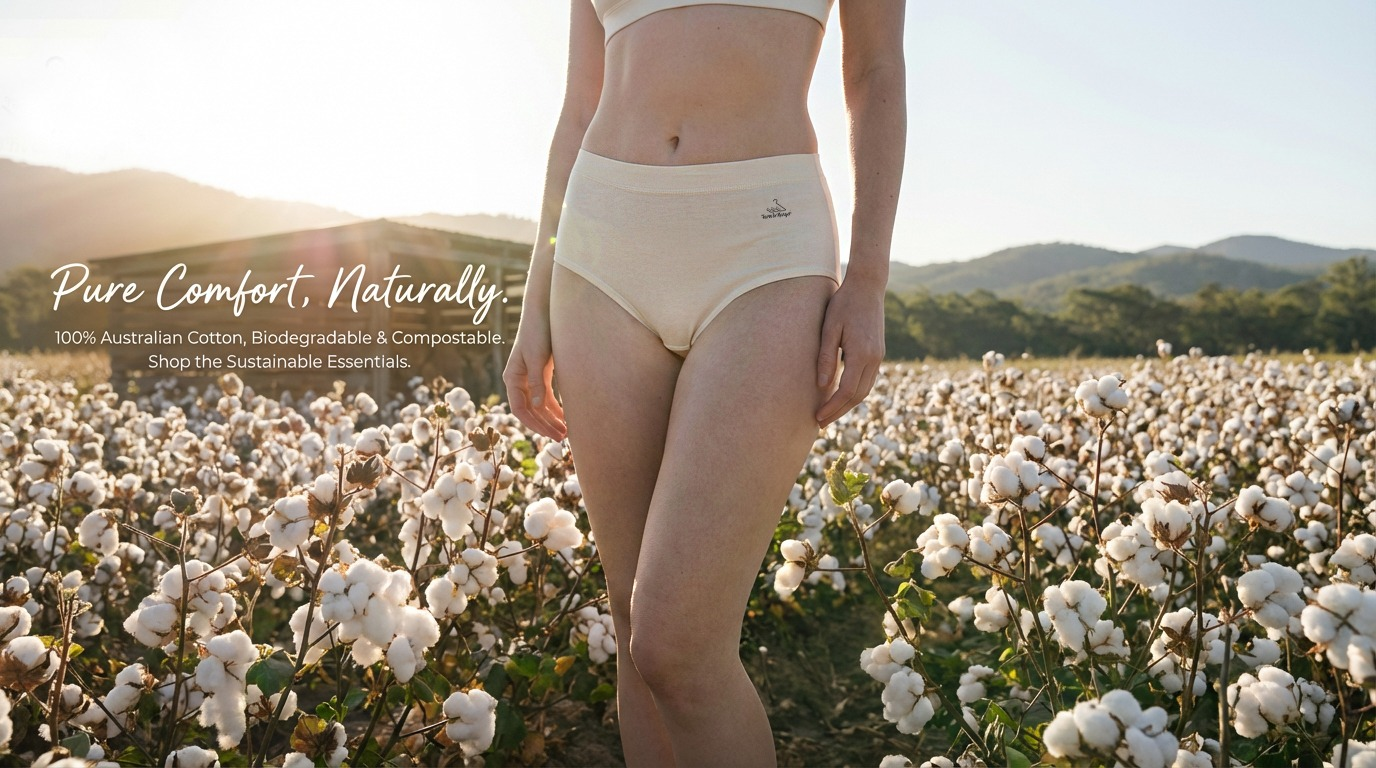
That decision shaped every layer of the business. The brand works with pure cotton knitted to its specifications, zero synthetic fibres, biodegradable elastics and thread, small-batch production, and Australian-made fabrics. Its natural, undyed range has become especially meaningful to customers who prefer garments with no added dye, no polyester, and a clean fibre story they can understand.
The mission sounds simple, but it is difficult in practice. Traceability requires discipline. Circular design requires restraint. Local manufacturing requires patience and cost control. Yet Farm To Hanger built its identity around those hard choices. From its first garment, the Humble Tee, to its growing selection of men’s and women’s underwear and clothing, the brand has stayed close to its founding promise: guilt-free garments that give wearers peace of mind.
Howard’s point was never only that better clothing was possible. It was that every choice in a garment matters. The cotton, the knitting, the sewing, the elastic, the thread, the cut, the finish, and the end-of-life plan all tell a story. In Farm To Hanger’s case, that story is designed to leave nothing behind.
Farm To Hanger Circular Fashion Proves Less Can Do More
The fashion industry often rewards volume. More ranges, more drops, more urgency, more waste. Farm To Hanger took the opposite path. Its collection is intentionally tight, with made-to-order and small-batch production helping conserve raw materials and reduce overproduction. Rather than chase every seasonal trend, the brand focuses on underwear and clothing made for comfort, durability, and practical daily use.
That restraint is one of its strongest commercial arguments. Customers are not merely buying a T-shirt, singlet, knicker, trunk, or activewear piece. They are buying relief from the quiet discomfort of not knowing what is in their clothing or where it came from. They are choosing garments made in Australia with craftsmanship and a visible supply chain. They are choosing comfort without synthetic fibres and without the sense that convenience must come at the planet’s expense.
Farm To Hanger’s position as Australia’s only 100 percent traceable circular fashion brand did not appear overnight. It required years of problem solving, including the challenge of textile waste. Circularity sounds elegant in a brand statement. In reality, waste must be stored, sorted, protected, and cared for until a true local solution exists. Howard and her team treated that responsibility as part of the mission, not an inconvenient afterthought.
The brand’s award recognition also reflects that seriousness. Farm To Hanger’s bra received an Australian Good Design Award, although it is not currently in production. The recognition matters because it shows that circular thinking and strong product design can belong in the same garment. For a small Australian company, that validation helped demonstrate that ethical production does not need to mean compromise.
Still, Howard’s story is not a glossy overnight success story. Doing things differently can attract resistance. Small brands that question large systems often carry a heavier burden, especially when their work exposes what could be changed across the industry. Farm To Hanger has had to remain committed through delays, sourcing challenges, public misunderstanding, and the pressure to simplify a message that is, by nature, deeply detailed.
Yet the brand’s clarity has become its advantage. While some companies speak of sustainability in broad language, Farm To Hanger can point to specific choices. Pure cotton. No synthetics. Biodegradable elastics and thread. Australian-made fabrics. Traceability to the paddock where the cotton is grown. Repair and recycling programs. Compostable garment components. These are not decorative claims. They are the framework of the business.
Farm To Hanger Circular Fashion Looks Ahead
Today, Farm To Hanger stands at a compelling moment. What began as a proof of concept has become a model for what responsible fashion can look like at a human scale. Its garments are designed to feel soft, useful, and trustworthy, but the larger value sits beneath the surface. The brand gives customers a way to participate in a different clothing economy without needing to become experts in textiles, supply chains, or waste systems.
That accessibility matters. People want to make better choices, yet they often face vague claims and confusing labels. Farm To Hanger reduces that confusion by building transparency into the product itself. When a garment is made from traceable cotton, sewn in Australia, designed without synthetic fibres, and considered for its full life cycle, the customer does not have to guess whether the values are real.
The brand’s circular approach is also moving beyond individual garments. Howard has described future work around fully circular yarn made from the company’s own textile waste, intended for use in future garment ranges. That kind of development points to a broader industry solution: traceable waste becoming a circular product outcome. It is the difference between managing waste and truly designing it back into usefulness.
For customers, the appeal remains beautifully practical. Farm To Hanger offers clothing that feels good on the body and better on the conscience. Its undyed natural range, pure cotton underwear, and everyday staples invite people to replace uncertainty with assurance. The value is not only in what the garment contains. It is also in what it avoids: polyester, hidden synthetics, unnecessary dye in selected styles, disposable thinking, and the empty comfort of fast fashion.
In a global market hungry for authentic sustainability, Farm To Hanger offers something rare. It is small enough to be accountable and mature enough to set a benchmark. It is Australian-made without being parochial. It is ethical without being ornamental. Most importantly, it proves that change is not theoretical. It has already been cut, sewn, worn, returned, repaired, recycled, and imagined again.
For anyone ready to rethink the first layer they put on each day, Farm To Hanger offers a clear next step: explore garments designed for comfort, traceability, and a lighter footprint from the first fibre forward. Visit the range, read the sustainability story, and choose clothing that lets you feel the difference of circular fashion against your skin and in your values. Connect with Farm To Hanger, Facebook, and Instagram.
Women’s Insider Contributor
Natalie J. Brooks
Natalie J. Brooks covers small business, branding, and digital culture. She brings a practical, accessible voice to topics that matter most to today’s women.
This article features partner, contributor, or branded content from a third party. Members of the Women’s Insider editorial staff were not involved in the creation of this content. All views and opinions are those of the contributor alone.
Related Posts
How MAARS Photo Built a New Approach to Maternity Photography in Toronto

Supercar Sisters Turns Car Culture Into Celebration
Inside Vestir: A New Way to Shop Luxury
Beyond the Bag: Amber Gentile's Luxury Vision

Women in Music Week Expands Spotlight on Female Artists Across Huntsville