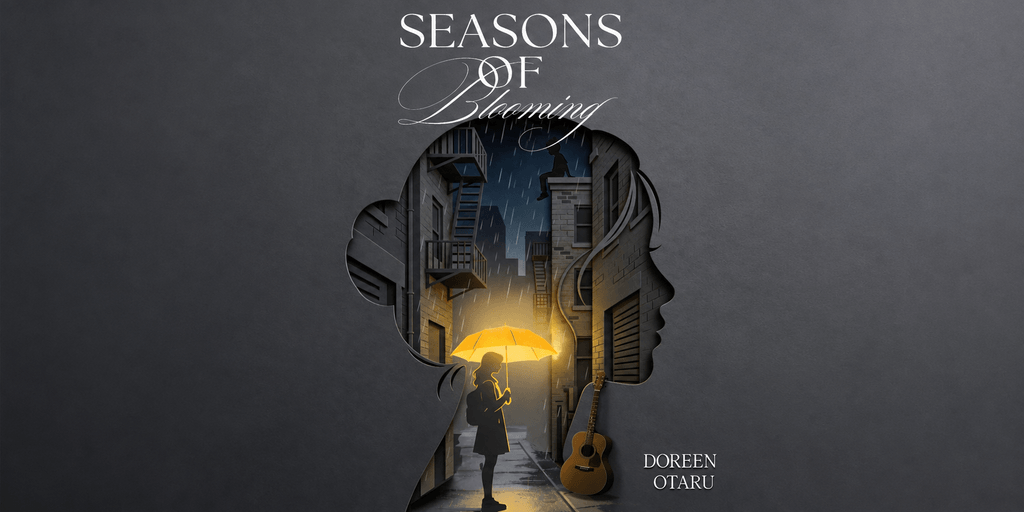
A twenty-one-year-old writer explores imperfect women, unfinished identities, and what it means to write about adulthood before arriving there yourself.
Doreen Otaru is twenty-one, approaching her final year at the University of Texas at Austin, where she studies Radio-Television-Film and Public Relations. Her debut novel, Seasons of Blooming, follows an eighteen-year-old girl standing at the edge of adulthood, which places only three years between author and protagonist. Otaru is candid about what that proximity means. She is not looking back on adolescence from some distant point of certainty. She is still growing up herself.
That is important to how she understands the book. Otaru does not want Seasons of Blooming to read as advice from someone who has figured out adulthood. If anything, she wrote the novel because she was interested in the questions for which she did not have answers. At eighteen, she once imagined college as the place where uncertainty would finally disappear. In college, that imaginary destination became graduation. Then came the prospect of a career, financial stability, relationships, family, and whatever milestone might follow those. There was always a future version of herself waiting somewhere ahead who seemed certain to understand what the present one did not. Otaru is beginning to wonder whether that person exists.
Three Years Between Author and Character
That realization sits quietly beneath Seasons of Blooming. Its protagonist, Solehn, is eighteen and convinced she should already know who she is. Instead, her family is unraveling, and she is being pulled away from New York during her final semester of high school. She leaves behind four girls with whom she had imagined the immediate future of her life: prom, graduation, college decisions, and all the ordinary experiences through which teenagers imagine they will cross into adulthood together.
What interests Otaru is not simply that Solehn’s life changes. It is the fact that Solehn is expected to interpret those changes while possessing very little distance from them. She makes decisions that are impulsive, contradictory, and sometimes plainly wrong. Otaru does not rescue her from those decisions. She does not want to.
Women Who Resist Easy Verdicts
“I actually expect some readers to dislike her,” Otaru says. Solehn says things she should not say. She hurts people and gets hurt herself. She can be deeply frustrating, but she can also be funny, loving, frightened, loyal, immature, and perceptive. Otaru allows those qualities to exist beside one another because she is interested in women who cannot be reduced to a verdict.
Her favorite color is gray, an appropriate preference for someone drawn to the space between right and wrong. Otaru is particularly resistant to the idea that female characters must be made easily defensible in order to remain sympathetic. “I want readers to look at them and say, what is she doing? Why would she say that? That was not okay,” she explains. Understanding a character does not require agreeing with her. Loving a character does not require acquitting her. Sometimes people make choices that are not narratively defensible, and then they have to live with what those choices reveal.
Storytelling Beyond the Page
That interest in complicated women extends beyond Solehn. Although Seasons of Blooming is Otaru’s debut novel, her creative interests are developing alongside an early career that has moved across development, production, marketing, and representation within the entertainment industry. At the University of Texas at Austin, her studies in Radio-Television-Film and Public Relations place her at an intersection between storytelling and the industries that shape how stories reach audiences. Still, Otaru is careful not to present those experiences as evidence that she has arrived anywhere. She considers herself at the beginning of both her creative and professional life. Perhaps that is why she is so interested in characters who are also unfinished.
Solehn does not move through Seasons of Blooming as a young woman steadily progressing toward the correct version of herself. She contradicts herself. She outgrows people. She clings to relationships because she does not yet know who she might become without them. She makes the kind of terrible decision that can feel completely rational at eighteen, and she experiences friendships with an intensity that might be difficult for her future self to reconstruct.
Taking the Present Seriously
One exchange between Solehn and her father captures that tension. He tells her, “All your problems are wrapped in things that won’t matter in three years.” Solehn responds, “But they matter now. And now is where I am.”
Otaru is interested in that “now.” At twenty-one, she is close enough to eighteen to understand why a friendship ending can feel catastrophic even if that same friendship may barely register ten years later. The knowledge that something will become insignificant eventually does not make it insignificant to the person experiencing it today. Solehn does not possess the wisdom of her future self. Neither, Otaru increasingly suspects, does anyone.
That uncertainty has begun to shape how she thinks about growing up. Maybe maturity is not the moment when uncertainty disappears. Maybe it is learning to live without requiring its disappearance. Maybe blooming is not the discovery of some predetermined self waiting patiently at the end of adolescence. It may instead be permission to keep changing.
From Solehn to Medusa
Otaru’s next project, Call Her Medusa, suggests that her fascination with complicated women will continue even as the genre changes. The story moves into darker territory, following a woman whose pursuit of justice eventually forces an audience to confront the line between protection and harm. The questions are different from those surrounding Solehn, but the creative instinct is recognizable. Otaru does not want to write perfect women. She wants to write women worth paying attention to, particularly when paying attention to them becomes uncomfortable.
That may ultimately be the clearest connection between the stories Otaru wants to tell. Her characters are not interesting because they know who they are. They are interesting because they do not. They occupy the gray spaces between childhood and adulthood, justice and harm, love and selfishness, certainty and doubt. They make decisions before they possess enough information to know whether those decisions are right.
Still Becoming
At twenty-one, Otaru is unwilling to exempt herself from that uncertainty. She is finishing college, developing a career in entertainment, writing new stories, and reconsidering an assumption she once carried about adulthood: that somewhere ahead exists a version of herself who will finally have everything figured out. Maybe there does not.
For a young writer whose first novel is called Seasons of Blooming, that possibility feels less like a failure than it once might have. Blooming does not have to mean arriving at a finished version of yourself. It can simply mean allowing yourself to continue becoming.
Doreen Otaru’s Emerging Creative Path
Doreen Otaru’s early path reflects a young artist learning the industry from multiple angles while still shaping her own voice. Her education and early career have taken her across development, production, marketing, representation, and storytelling. Her experience includes internships and work connected to Creative Artists Agency, the Texas Film Commission, ReFrame x Women in Film, Yoruba Saxon, Brass Knuckles, Burr! Productions, and award-winning entertainment professionals.
Her next project, Call Her Medusa, continues her interest in complicated women through a darker lens, exploring justice, harm, and the difficulty of deciding who is entirely right. The genre may change, but the creative instinct remains consistent. Otaru wants to write women worth paying attention to, especially when paying attention becomes uncomfortable.
That is also why Seasons of Blooming feels less like a lecture and more like a companion. It does not tell young women how to mature. It sits beside them while they do. It gives dignity to the messy middle, to the moment before clarity, when all a character can do is survive herself and keep becoming.
For readers drawn to coming-of-age stories that trust young people with emotional seriousness, Seasons of Blooming offers a purposefully imperfect mirror. It invites readers to hate Solehn for fifty pages, understand her on the fifty-first, and perhaps remember a version of themselves they once judged too harshly. Explore Doreen Otaru’s debut if you want a novel that does not promise certainty, but offers something more honest: the relief of realizing that uncertainty can still be a beginning. Connect with Seasons Of Blooming, LinkedIn, and Instagram.
Women’s Insider Contributor
Rachel M. Collins
Rachel M. Collins specializes in entrepreneurship, media, and contemporary culture. She writes with a reader-first approach, blending clarity with thoughtful storytelling.
This article features partner, contributor, or branded content from a third party. Members of the Women’s Insider editorial staff were not involved in the creation of this content. All views and opinions are those of the contributor alone.
Related Posts

Christina Paap: Building Bridges in Innovation

PandaSays AI Helps Children Speak Through Art

Diana Kemp Dreamscapes: How a Lifelong Writer Found the Courage to Paint

Sanctuary Sleep Reimagines Pillow Support

Why Skin Revive Cosmetics Elevates Med Spas