
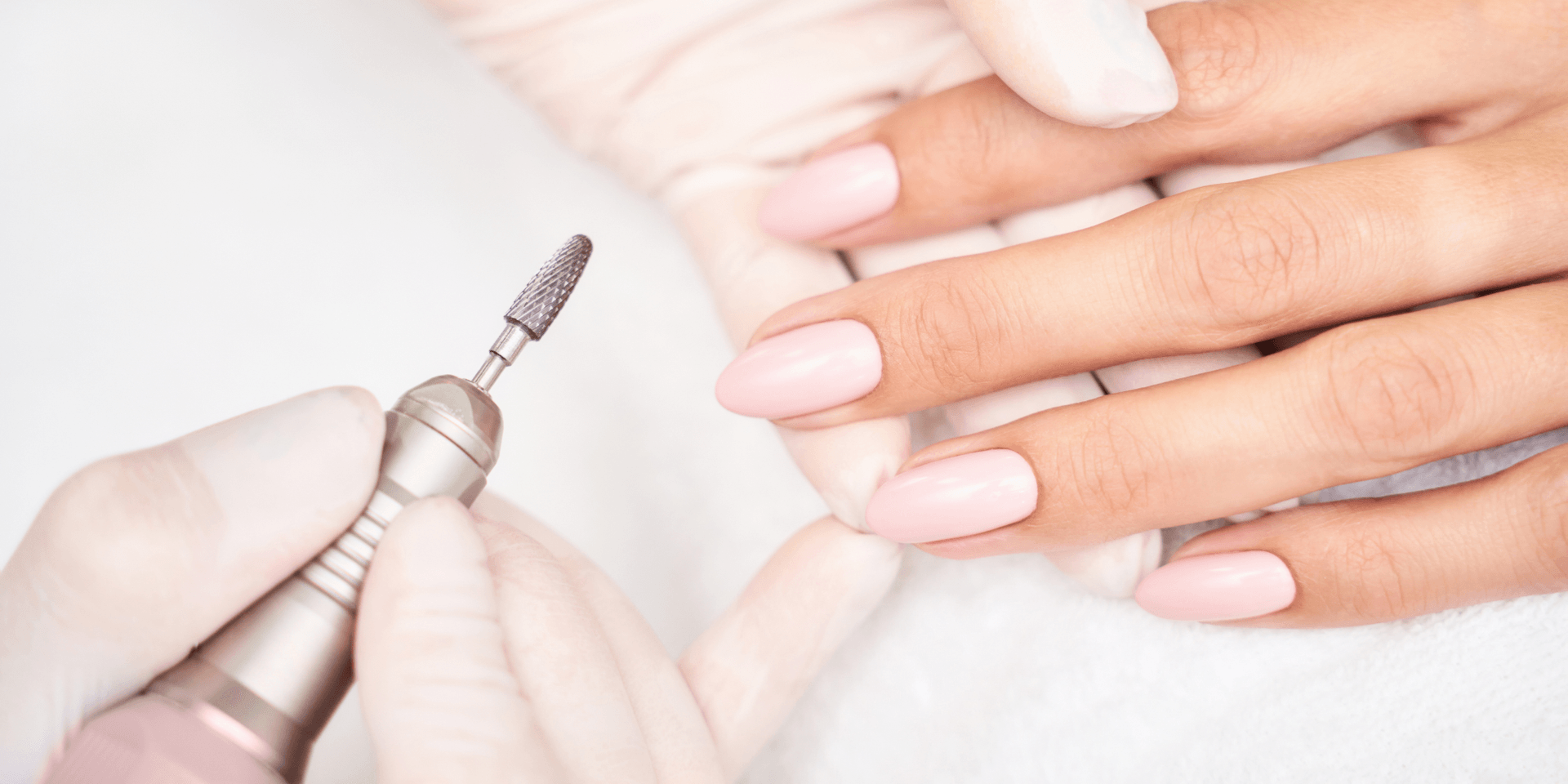
Discover the precision techniques behind longer-lasting manicures, plus the expert tips that help protect your natural nails from damage.
By: Mary Rosen
Longer wear, cleaner lines, fewer chips. The techniques everyone is booking right now all promise the same thing, and the difference between a great result and a damaged nail almost always comes down to the person holding the tool.
Something shifted in nail salons over the past couple of years. The conversation stopped being only about color and started being about structure: how thick the gel is, where the strongest point of the nail sits, how close the product goes to your skin, how much of your natural nail is left underneath.
That shift is why your feed is full of terms that sounded like insider jargon a few years ago. Russian manicure. BIAB. Structured gel. Gel-X. Apex. If you have ever left an appointment with nails that peeled in four days, or with sore, red skin around your cuticles, the vocabulary is worth learning. Here is what these services actually are, what the risks are, and the questions that separate a skilled tech from an expensive problem.
The E-File Manicure Everyone Is Arguing About
Call it a Russian manicure, a dry manicure, or an e-file manicure. The technique uses a small electric file with fine bits to clear the cuticle area with a lot of precision, so gel can be placed right up to the skin line. The payoff is visual and practical at once: no visible regrowth gap for around three weeks instead of one, because the color starts exactly where your nail starts.
Dermatologists are genuinely split on it, and it is worth understanding why. The American Academy of Dermatology's standing guidance is not to cut or forcefully push back cuticles, because that seal is what keeps bacteria and irritants out of the nail unit. Board-certified dermatologist Elizabeth Kiracofe told ABC7 Chicago that she liked the results when she tried the service herself, while still having concerns about how the filing is done. Cornell dermatologists have described seeing patients arrive with infections after overly aggressive nail work.
Here is the nuance that gets lost in the online fighting: a correctly performed version works only on dead keratin sitting on the nail plate, which has no blood supply and no nerve endings. It should not hurt and it should not bleed. If it does either, living tissue was touched.
So the honest verdict is not "safe" or "unsafe." It is operator-dependent. The technique rewards training and punishes speed.
Structured Gel and BIAB, or Why Your Manicure Keeps Chipping
A structured gel manicure adds a builder gel over your natural nail, shaped so the thickest point sits where the nail takes the most stress. That thick point has a name, the apex, and its placement is the single most underrated variable in whether your manicure survives three weeks or three days.
BIAB, short for builder in a bottle, is the version most people have heard of. It started as a specific patented system from The Gel Bottle, created by nail technician Daisy Kalnina, and the name has since become a catchall the way Kleenex did. All BIABs are builder gels; not all builder gels are BIAB.
The appeal is straightforward: a reinforced layer over a weak or bendy natural nail, without extensions, and gel polish can still go on top. The failure mode is equally straightforward. Too much product, or product piled in the wrong place, makes a manicure heavier without making it stronger, and a misplaced apex is why the free edge cracks.
Everyone Says “Acrylics.” Most of the Time They Mean Something Else
Celebrity manicurist and educator Julie Kandalec has pointed out that clients rarely know how many categories exist, from soft gel to semi-hard gel to long-wear lacquer systems. Celebrity nail artist Tom Bachik makes the same point about the word acrylic, which people use generically when what they are actually getting is Gel-X, a soft gel tip bonded and cured with gel rather than sculpted with liquid and powder.
This matters for your nails, not just your vocabulary. Removal differs by system, and improper removal, meaning filing down to the natural plate or prying anything off, does more damage than the product ever did.
The Quiet Shift: Technique as a Protocol
The most interesting development in professional education right now has nothing to do with color. Educators are teaching nail enhancement in the language of load and geometry: measure the natural plate, decide where the apex goes, control thickness by zone, then check the result against defined parameters instead of eyeballing it.
Some artists have formalized that into written methods. One example is ALF-SEM (Advanced Lower-Form Structural Enhancement Method), developed by San Diego based nail artist Hanna Khalin, who laid the system out in a book covering the full sequence, the checkpoints, and the sanitation protocol. It builds on lower forms rather than the closed upper forms common in fast salon work, on the argument that an open structure lets the artist adjust material layer by layer and avoid pressing on the nail bed. Salons and training programs in California, elsewhere in the US, and abroad now work with it. Other educators favor upper forms for speed and consistency.
You do not need to pick a side in that debate. What you should notice is the underlying shift: the best technicians now work from a repeatable protocol, which is exactly why their results do not vary from client to client or from Monday to Friday.
The Risk Nobody Mentions When You Book
Allergic contact dermatitis from gel products is rising, and it is the one complication that can follow you for life.
The chemicals involved are acrylates, most notably HEMA. When gel is applied too thick, floods onto the skin, or is not fully cured under the lamp, reactive monomers stay in liquid form and can absorb into living skin. Repeated exposure over months is what triggers sensitization. Once your immune system flags acrylates, it can react to them elsewhere, including dental bonding agents and medical adhesives.
Dermatologist JiaDe Yu at Massachusetts General Hospital told TIME that patients often show up with rashes nowhere near their hands, on the eyelids, neck, or face, which is what makes these cases so hard to connect back to a manicure. The at-home gel boom has made it more common, because consumer kits frequently pair strong formulas with underpowered lamps.
Regulation has not caught up in the US. The European Union restricted HEMA-containing nail products to professional use, while American consumers can buy the same chemistry over the counter with no warning label.
Symptoms worth taking seriously: itching or burning around the cuticles, small blisters, peeling skin, or nails that lift at the base. See a dermatologist rather than switching brands and hoping.
What to Ask Before Your Next Appointment
Are the tools coming out of a sealed sterilization pouch? If bits come out of a drawer, leave.
What is being used on my natural nail? Sanding bands do not belong on the nail plate.
Where did you train on the e-file? Technicians with real training are happy to answer this.
Is my gel being cured with your lamp, in the time the manufacturer specifies? Mismatched lamps and gels are a leading cause of undercuring.
Does any product touch my skin? It should not.
And one thing to watch on yourself: if a service ever hurts, that is information, not endurance. Well-executed precision work on nails is not supposed to be felt.
Women’s Insider Contributor
Emily R. Parker
Emily R. Parker is a lifestyle and business writer with a focus on wellness, career development, and modern leadership. Her articles highlight real-world strategies for women balancing ambition and well-being.
This article features partner, contributor, or branded content from a third party. Members of the Women’s Insider editorial staff were not involved in the creation of this content. All views and opinions are those of the contributor alone.
Related Posts

Beyond the Bag: Amber Gentile's Luxury Vision

Women in Music Week Expands Spotlight on Female Artists Across Huntsville

Dr. Nicole Schtupak and The Phoenix Lens Method

From the OR to Telehealth: Ginny Ondik's Bayan Health

Dr. Jessica Saulsberry Supports Balanced Leadership Development
