



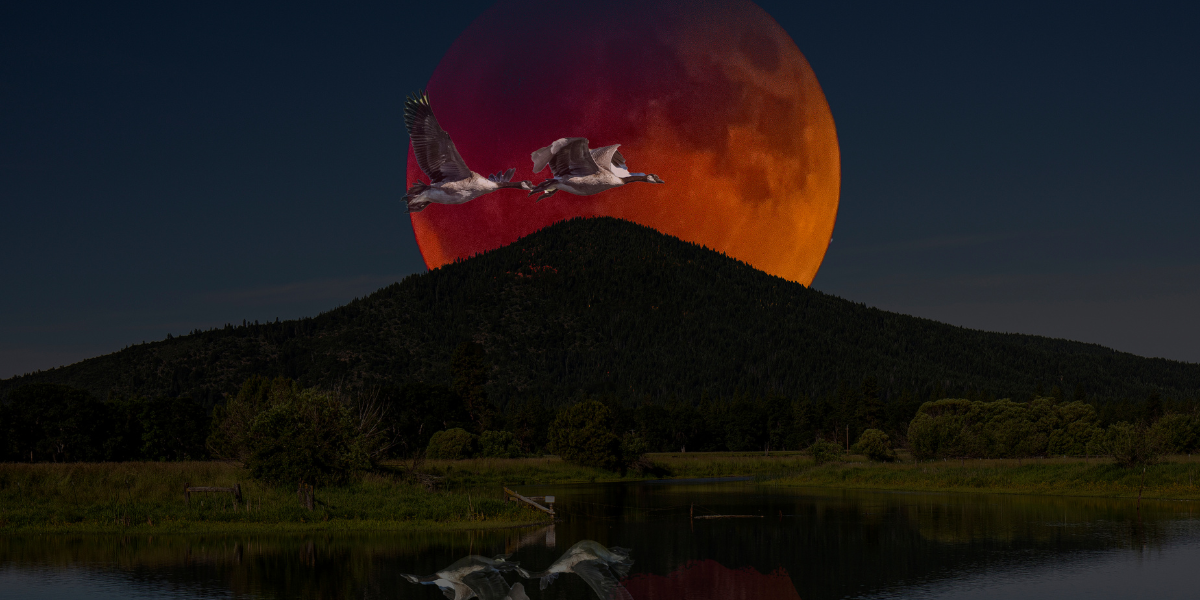
A total lunar eclipse illuminated skies across the United States late Monday night into the early hours of Tuesday morning, offering millions of Americans a rare and breathtaking view of what is commonly known as a “Blood Moon.” The celestial event, visible across much of North America, transformed the Moon into a deep reddish hue during totality, creating a striking visual spectacle that drew widespread public interest.
A lunar eclipse occurs when the Earth moves directly between the Sun and the Moon, casting its shadow onto the lunar surface. During a total lunar eclipse, the Moon passes entirely into Earth’s darkest shadow, known as the umbra. As sunlight filters through Earth’s atmosphere, shorter blue wavelengths scatter while longer red wavelengths bend and reach the Moon. This atmospheric filtering effect gives the Moon its distinctive copper or crimson color during totality.
Unlike a total solar eclipse, which is visible only along a narrow path and requires protective eyewear, a lunar eclipse can be safely observed with the naked eye and is visible anywhere the Moon is above the horizon on the night side of Earth. This accessibility makes lunar eclipses especially popular among families, educators, and amateur astronomers.
The eclipse began with the penumbral phase late on March 2, when the Moon entered the Earth’s outer shadow and dimmed subtly. The partial phase followed, as a noticeable dark shadow moved across the lunar surface. The most dramatic stage, totality, lasted nearly an hour in many parts of the country. During this time, the Moon glowed in shades ranging from burnt orange to deep red, depending on local atmospheric conditions such as dust and cloud cover.
Viewing conditions varied by region. In western states, observers were able to see the full progression of the eclipse before dawn. In central areas, much of totality was visible before the Moon set. In parts of the eastern United States, the Moon began setting as the eclipse progressed, offering a dramatic scene of a darkened, reddish Moon near the horizon at sunrise.
Astronomy organizations, science museums, and community groups hosted viewing events across the country. Parks and observatories opened early or stayed open late to accommodate visitors eager to witness the phenomenon. Social media platforms were quickly filled with images captured by both professional photographers and everyday skywatchers using smartphones and basic camera equipment.
Beyond its visual appeal, the eclipse served as a reminder of the predictable rhythms of the solar system. Lunar eclipses occur only during a full Moon, when the Sun, Earth, and Moon align precisely. However, not every full Moon results in an eclipse because the Moon’s orbit is slightly tilted relative to Earth’s orbit around the Sun. When the alignment is exact, the result is a total or partial lunar eclipse.
Events like this also provide meaningful educational opportunities. Teachers often incorporate eclipses into lessons about planetary motion, gravity, and light. For children and teenagers, witnessing such an event firsthand can spark curiosity about space science and STEM-related fields. The simplicity of viewing, no equipment required, makes participation accessible to a broad audience.
Culturally, lunar eclipses have held significance for centuries, appearing in folklore and historical records around the world. Today, while the science behind the phenomenon is well understood, the emotional impact remains powerful. Seeing the familiar Moon transformed in color and brightness creates a shared moment of awe that transcends age and background.
For many Americans, the timing of this eclipse, occurring as winter transitions toward spring, added symbolic resonance. Clearer seasonal skies in several regions enhanced visibility, while cooler nighttime temperatures encouraged bundled-up gatherings under the stars. Families, friends, and neighbors stepped outside together, reinforcing a sense of community centered on a natural event that required nothing more than looking up.
Astronomers note that while lunar eclipses are not exceedingly rare, total eclipses visible across large portions of the United States do not happen every year. This event marked one of the most widely observable total lunar eclipses of 2026, making it particularly special for those who had missed previous opportunities.
As the Moon gradually emerged from Earth’s shadow and returned to its familiar bright glow, the event concluded quietly, leaving behind photographs, memories, and renewed interest in the night sky. For many, the “Blood Moon” of March 2026 served as both a scientific lesson and a moment of shared wonder, an accessible reminder of the dynamic universe just beyond our atmosphere.
