




Challenging expectations, this editorial disrupts Target’s practicality with bold beauty, asking who gets to take up space.
I didn’t choose Target because it was ironic.
I chose it because it was honest.
This editorial was shot inside one of the most familiar spaces in America , bright aisles, fluorescent lights, mass-produced comfort. A place designed for efficiency, not fantasy. And that was exactly the point.
Fashion editorials often rely on distance: exclusive locations, controlled environments, visual elitism. But I wanted something different. I wanted friction. I wanted to place beauty where it isn’t expected , and sometimes isn’t welcomed.
So I climbed into the shopping cart.
I wore pink in a space where practicality is rewarded.
I disrupted the aisle without touching a single product.
Target is where life happens quietly. It’s where women shop for their families, for themselves, for survival, and for small pleasures. It’s a space tied to care, labor, and routine , rarely to desire. Rarely to spectacle.
By inserting an editorial body into that environment , elevated, playful, impractical , I wanted to ask a simple question: Who gets to take up space, and where?
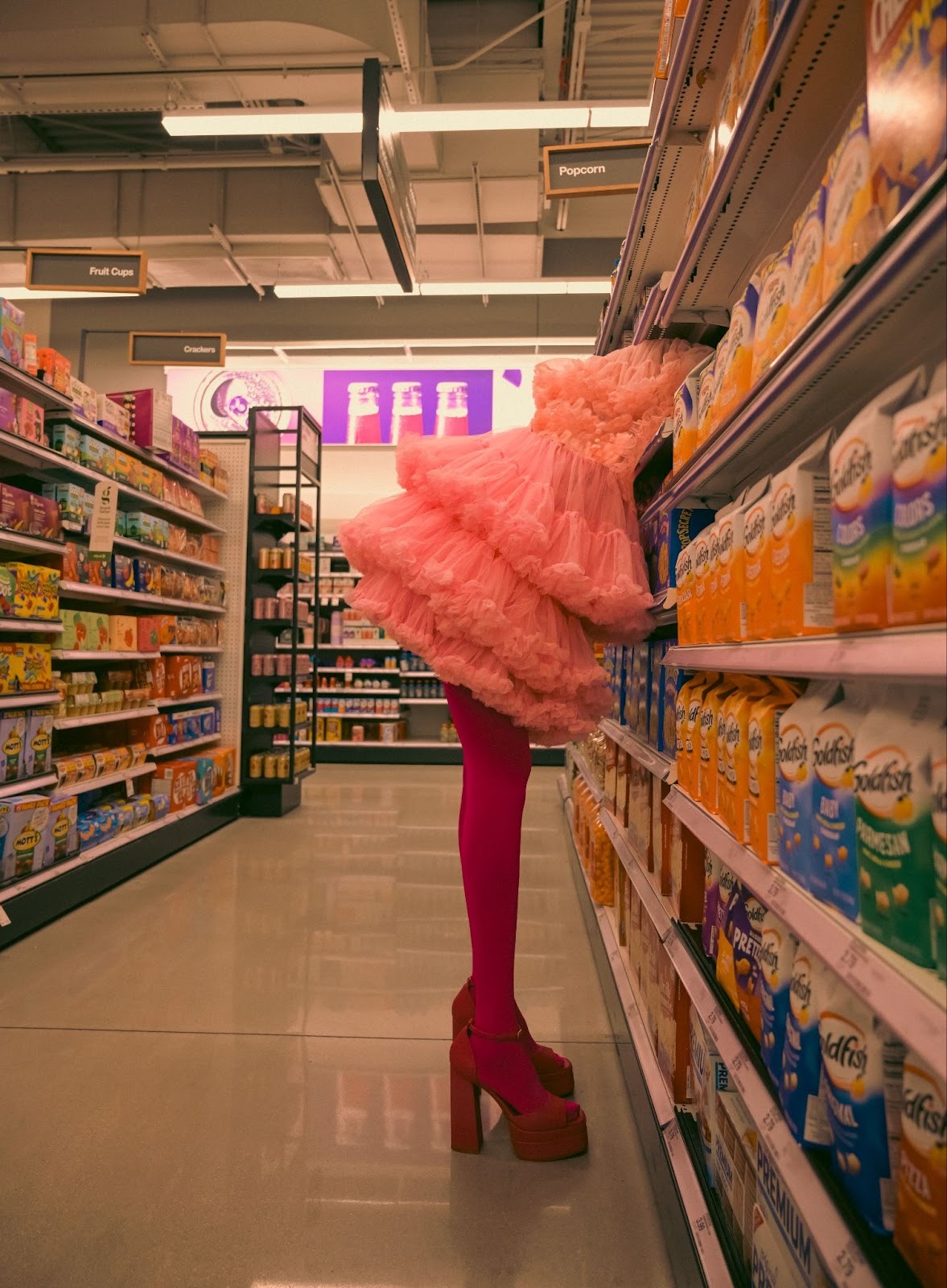
The work isn’t about consumption. It’s about contrast. The contrast between fantasy and function. Between how women are expected to move through public space , efficiently, politely, invisibly , and what happens when that expectation is broken.
The poses are exaggerated. The color is intentional. The styling refuses subtlety. In a place built for sameness, excess becomes language.
This editorial isn’t rebellion for rebellion’s sake. It’s observation. Target reflects how culture organizes value: what is necessary, what is indulgent, what is acceptable. By staging something impractical inside a practical world, the editorial exposes how tightly those boundaries are enforced.
There was no set. No permission. No spectacle beyond what already exists in the American consumer landscape.
Just a reminder that art doesn’t need rarefied spaces to be valid. Beauty doesn’t disappear just because it shows up in the wrong aisle.
Sometimes the most radical thing you can do is exist unapologetically where you were never meant to perform.
This approach of challenging spaces and redefining expectations reflects the innovative work done at J.Creative International. Led by Jennifer Ubebe, the company focuses on breaking down the traditional creative barriers and introducing a new framework designed for a globalized world. Like this editorial, which places beauty in an unexpected setting, J.Creative International seeks to bring creativity to places where it’s least expected and often most needed.

J.Creative International isn’t about following old models of production. Instead, it creates an integrated, global system that enables brands to move across continents without losing their unique narrative. Ubebe’s philosophy challenges the traditional idea that creative work must be confined to certain spaces. Instead, her approach allows creativity to flow freely, across both geographic and cultural boundaries, without losing its essence.
With teams in the United States, Europe, and Nigeria, J.Creative International offers a truly global approach to production and creative direction. Local teams contribute regional expertise while a centralized vision ensures consistency across markets. This allows for creative work that remains true to a brand’s identity, no matter where it’s being executed. The company’s model breaks down barriers between local execution and global vision, ensuring that work is as cohesive as it is culturally informed.
J.Creative International’s focus isn’t just on the technicalities of production, but on the integrity of creative vision. Whether it’s fashion, lifestyle, or commercial work, Ubebe’s model emphasizes that creativity is best when supported by a clear, structured system , one that doesn’t dilute a vision as it scales but instead aligns teams, cultures, and regions towards a singular goal.
This kind of creative thinking isn’t just about making art or advertising; it’s about making a statement. Just like the editorial in Target, J.Creative International understands that the most radical thing you can do in today’s world is create something unapologetically, without worrying about whether it fits into the spaces where it’s “supposed” to belong.
Explore more about the innovative work at J.Creative International.
